

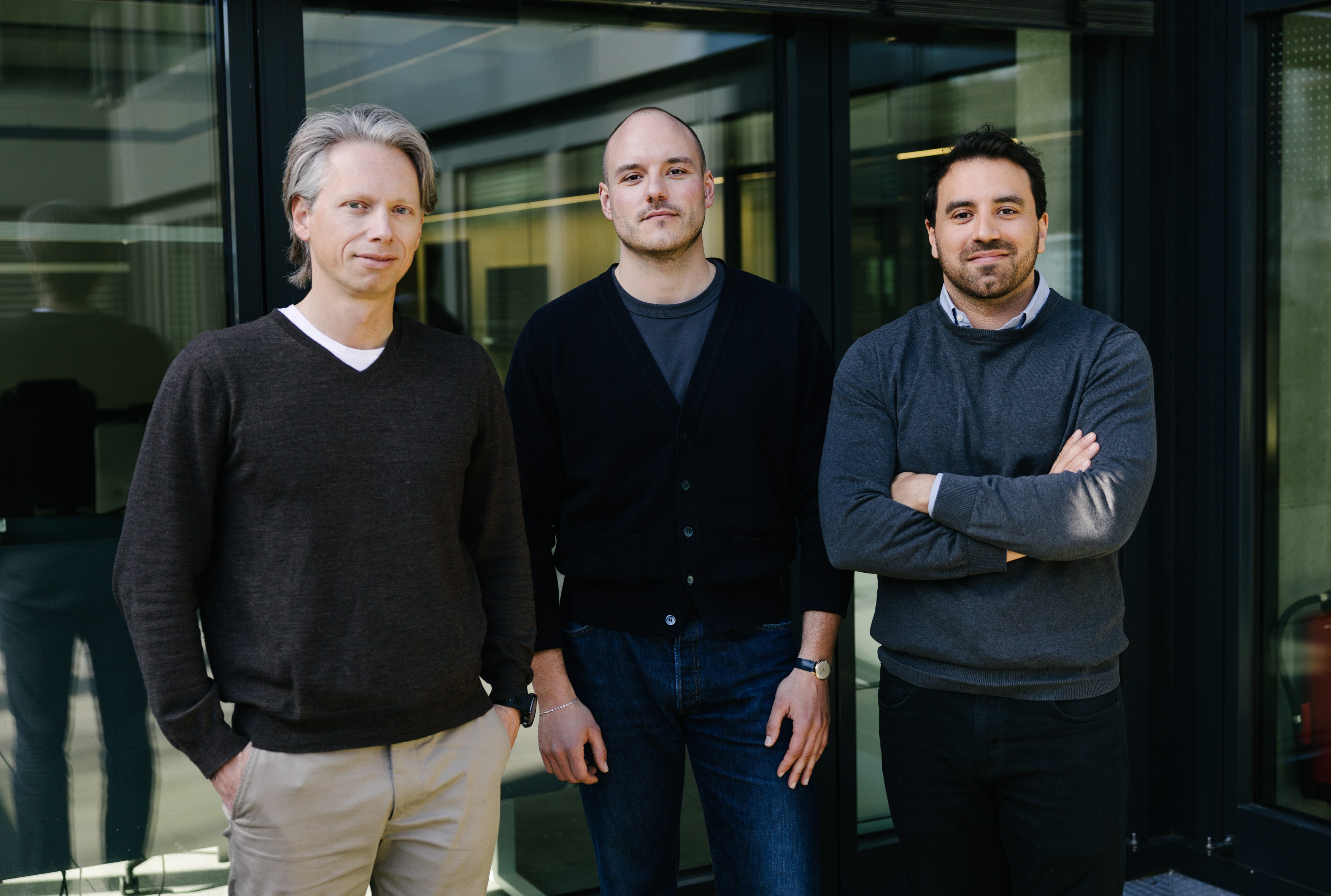
Miguel Conty (CEO) and Christian Rosan (CTO), co-founders of METEORIC, are building a new interface for energy markets and industrial companies. Backed by Merantix Capital, they combine deep energy expertise with AI-driven automation to make energy supply more transparent, responsive and efficient.
The founders bring decades of combined experience across energy consulting, portfolio management, commercial energy supply and renewable energy systems. Their shared ambition extends beyond conventional procurement: they want to transform energy from a fragmented, periodically managed cost into a continuously optimised business function.
The founders of METEORIC started their journey with Merantix Capital Venture Studio after realizing the current demand of industrial energy companies. They discovered that modern industrial companies are aiming for operational resilience along with cost competitiveness. With bulk data in terms of contracts, load profiles, and sophisticated energy management, it becomes a mental hassle for customers to rely on the traditional supplier model that is mostly fragmented across spreadsheets.
METEORIC addresses this problem by combining energy supply, portfolio management and software within one integrated operating model. Its AI-supported system automates repetitive processes, analyses market and consumption data, and helps companies make better procurement and operational decisions. Customers receive a solution tailored to their sites, consumption patterns and risk preferences, while retaining transparency and control.
Rather than providing another isolated dashboard, METEORIC aims to become the operating layer for industrial energy. Its technology can work alongside an in-house energy management team, giving customers access to the expertise and infrastructure they need without requiring them to manage every market interaction themselves.
Christian and Miguel both agree that their vision is best aligned with Merantix, which enabled them to make their dream a reality. We spoke about combining artificial intelligence with energy expertise, the limitations of traditional supply models and their vision for the future of industrial energy.
Who is METEORIC and what does it do? Is it a software, a supplier, or a middleman for energy consumers?
Christian: METEORIC is building the interface between the energy market and industrial companies. We aim to give customers everything that they need from a single source, all tailored to their company’s portfolio. Most energy SaaS players only cover one part of the workflow, but we at METEORIC are trying to cover the full chain: a) supplying gas and power, b) building the decision and c) supporting their supply infrastructure.
As for our role, we basically support all three, but our current priority is to be a new generation supplier. If a customer is engaged in a long-term contract with another supplier, we can still support them as an intermediary and optimize their processes. This flexibility is important for us because companies cannot change every contract overnight. Becoming the supplier allows us to manage the customer’s portfolio more effectively and produce better ROI for them.
What does your service look like and how is it different from traditional energy management?
Christian: Our service begins with analyzing the customers’ historical consumption data. Based on this data, we make an offer for the energy supply and identify optimization opportunities. These opportunities can include sourcing third-party renewable volumes from PV or wind assets, reducing grid costs, shifting energy use to cheaper times of day, assessing battery installations, monetizing flexibility, and helping customers access short term power markets for last-minute changes. The point is to offer everything that traditional suppliers do in a more efficient way and also offer additional and more complex services where it makes sense to the customer.
What differentiates METEORIC from traditional models is that we are a one-stop shop. We not only provide gas and power, but also enable customers to make better operational and procurement decisions.
From the customer perspective, what are the biggest pain points that they face?
Miguel: The most challenging aspect is dealing with fragmented data and turning it into decisions. Companies have to analyze data from different interfaces, and it’s just not enough. They also want recommendations and support in decision-making. In the end, it always comes down to collecting data, analyzing it, and turning it into recommendations. That is how we create value.
Christian: Another problem is that the market is evolving. Customers need to focus on their main business, so they find it difficult to stay updated with energy complexities. We at METEORIC provide value by taking all this information and condensing it to enable better decisions. Our goal is to be the one interface to the customer. In some cases, we work with partners, and in some we provide the service ourselves. The point is to reduce mental load for the customer.
It seems like METEORIC has a lot to do with AI and is enabling AI to produce better outcomes. How does AI fit into your internal team workflows?
Christian: AI is an enabler. We use AI internally to automate work, keep the organization lean, and reduce costs. This means lower fees for customers as well.
We want to be clear that AI is not replacing domain expertise; it’s just automating and accelerating work. Work that once required weeks can be done in a few hours. AI helps generate the initial code, so the team doesn’t start from a blank page. Everyone in the company has access to internal agents.
What’s the difference between agents and assistants? Why is it important to fully understand this difference?
Christian: Assistants can give feedback, but agents can perform tasks autonomously in the background. Assistants can help you think, while agents can do the job for you. That changes the economics of operations. We see the current moment as the beginning of the ‘age of agents’ and companies cannot ignore these workflows anymore. Companies need to invest in actual agents that can execute the workflows. We see that in many industrial companies there is internal resistance, mainly due to compliance and data security topics. There is a great need to solve these hurdles and build practical capability, which is why we believe this is the right time to build METEORIC.
In terms of practicality, what data sources are you feeding the platform?
Christian: There are several sources. We connect with energy market data such as spot prices and forward prices. We also take customer-side offtake and machine measurement data that comes through the market players and grid operators. This data can be used to improve forecasts, which reduces cost. We also gather external information about batteries, renewable PPAs, and other similar opportunities. Then we combine all these sources and send back optimized outputs. Plus, we also have a regulatory layer, where the company screens new rules and helps customers understand how to position themselves in the framework.
Miguel: There is a shared base layer as well. We use all these information sources to create individual modules tailored to customers’ needs. Although some of these modules can be reused by other companies, the delivery is still customized. Our goal is to combine a common technological backbone with modular add-ons that fit every specific customer.
Does METEORIC also integrate physical assets like solar, batteries, or EV charging infrastructure?
Christian: Yes, we are building interfaces for on-site PV, batteries, and EV charging. We at METEORIC act as the energy and software provider, and we integrate with third parties that focus on hardware. This allows us to sit at the operational layer, managing data and energy flows while our partners take care of the physical equipment.
What is your expansion strategy for the future? How do you think energy enterprises will evolve?
Christian: For us, Germany is the proving ground because it is a complex energy market. If our system can serve German industrial clients, that gives us credibility. The next step for us is to follow our existing customers into other energy markets adjacent to Germany, and afterwards even beyond Europe. Our platform is adaptive, but we want to take it step-by-step.
Our approach is customer-first. A sensible plan is to start with our old customers and analyze whether serving them in another market would be feasible. Then compare how the local market culture is similar to Germany and work with a local partner to bridge the gap. Over time, if the market proves attractive, METEORIC might expand its own footprint there.
In the future, the enterprises will become much more automated as well. Agents will be handling procurement and negotiation. Companies that are digital-first and API-first will have a systematic advantage. But that does not mean that the domain experience will vanish.
There is a lot of anxiety going on around AI agents. Do you think they will replace jobs?
Christian: Companies should use automation to increase output rather than cutting headcount. Instead of getting work done with fewer people, the better move is to always engage the workforce with harder problems, generating more revenue and becoming more competitive. AI is not here to shrink ambition; rather, it’s here to enhance industrial competitiveness, especially in German markets.
How did you start your journey with Merantix?
Miguel: We chose Merantix as our investor because we were looking for more than capital. We wanted investment but also practical and proven advice on how to build a company. We came from the corporate side, so it was important for us to be with someone who understood the startup path. The ecosystem we built with Merantix brought us leads, discussions, customers, and a broader network.
Any last message that you would like to give our readers?
Miguel: METEORIC is the interface for companies dealing with complex energy portfolios and difficult energy decisions. We want to become the AI driven one-stop shop for industrial clients when it comes to power markets. Therefore, we are also open to hiring smart people who are eager to shape the future of the energy market.
Thanks, Miguel and Christian, for chatting with us!
For more information, visit their website: https://meteoric.energy/en